S Services · Jewellery
Shopify design & development for jewellery brands
Jewellery is bought on detail and trust. The store has to show a piece at the scale a jeweller’s loupe would — real zoom, consistent lighting, the clasp and the hallmark — and it has to make choosing a ring size or a metal feel like a fitting, not a form. Add gold that reprices daily and customers who read Arabic, Japanese or Korean, and a stock theme runs out of road fast.
GooGoGoGo designs and builds Shopify stores for jewellery brands end to end: theme design, product-page structure for variants and personalisation, multi-language and multi-currency storefronts, and the structured data that gets pieces into rich results. Three of the client stores on this site are jewellery stores you can open right now.
Scope it on a free call Free first concept before any deposit — we reply within 24h.
- 22 client stores you can open
- 29 free Shopify tools, live now
- $299 where fixed-scope fixes start

What a jewellery store has to get right
The same handful of things separate jewellery stores that convert from ones that just look expensive.
- Imagery at loupe scale. Zoom that actually zooms, on-model and on-white for every piece, video for movement and sparkle. The theme must serve large images fast — that is a performance job as much as a photography one.
- Variants that read like a fitting. Size guides next to the selector, metal and stone choices that swap the image, out-of-stock combinations that cannot be selected. A wrong size is a return, and returns on jewellery are expensive.
- Personalisation without chaos. Engraving, initials and birthstones need structured fields that flow to the order intact — not a free-text box the workshop has to interpret.
- Pricing that survives the metal market. When gold moves, hundreds of prices move with it. Prices need to be computed from weight and rate, not retyped, or the store is either underpriced or permanently out of date.
- Proof in the right places. Certification, hallmarking, materials and returns policy belong next to the price, because that is where the hesitation happens.
- Languages and currencies for where the customers are. Gulf, East Asian and European jewellery buyers each expect their own language, currency and layout — including right-to-left when the language calls for it.
How we build it
Every jewellery build starts from the product page and works outward, because that is where the decision is made.
- A product-page system first. Gallery, variant logic, size guide, personalisation fields and proof blocks are designed as one component set, then reused across the catalogue. New pieces inherit the whole system.
- Structured data for pieces, not just products. Product schema with material, size and availability per variant, so pieces qualify for rich results and price-aware shopping surfaces.
- Markets done properly. Languages and currencies through Shopify Markets with hreflang, translated content per product, and right-to-left layouts built with logical CSS so the mirrored version is a first-class store.
- Speed as a feature. Large imagery, lazy-loaded correctly, with Core Web Vitals checked on real phones — a jewellery store that stutters loses the sense of quality it is trying to sell.
- A first concept before any deposit. You see a real design direction for your store before committing to a build. Larger builds start with a deposit only once you are happy with it.
Work in this category
Real client stores, each with its own case study. Open them; everything on this page is verifiable there.
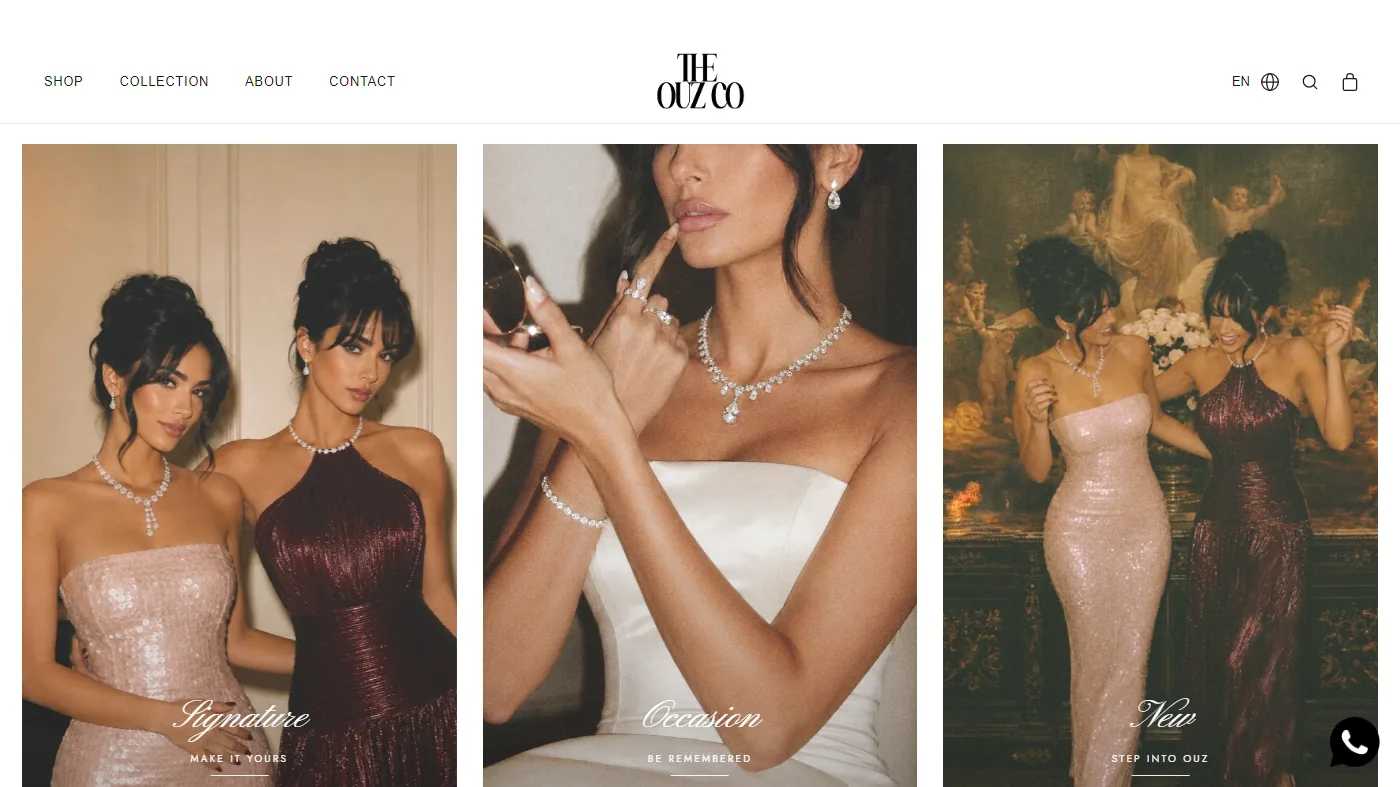 JewelleryThe Ouz Co
A custom Prestige build running English and Arabic side by side, with a full right-to-left layout and a shop-by-shape browser.
Read the case →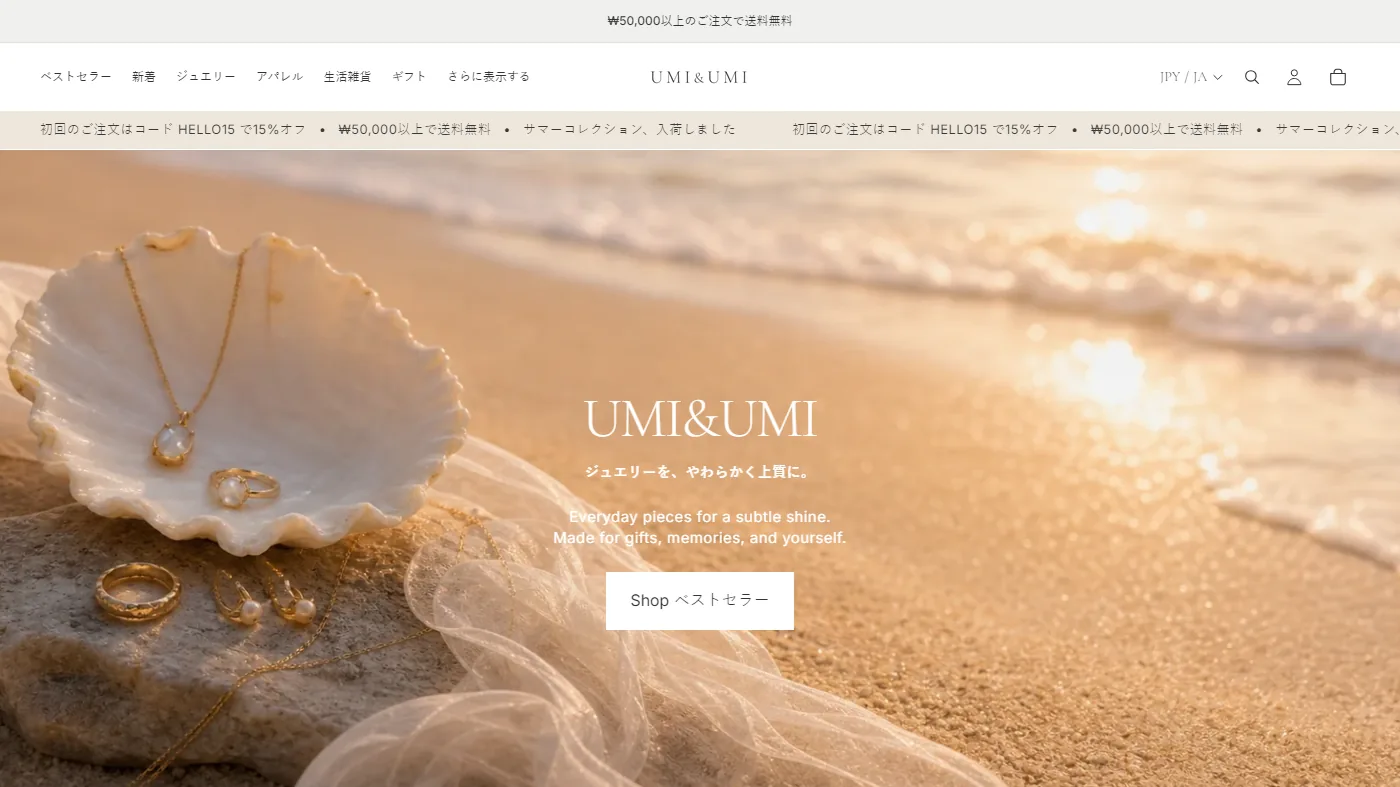 JewelleryUMI&UMI
A customised Horizon storefront running Japanese, Korean, English and Simplified Chinese side by side, currency included.
Read the case →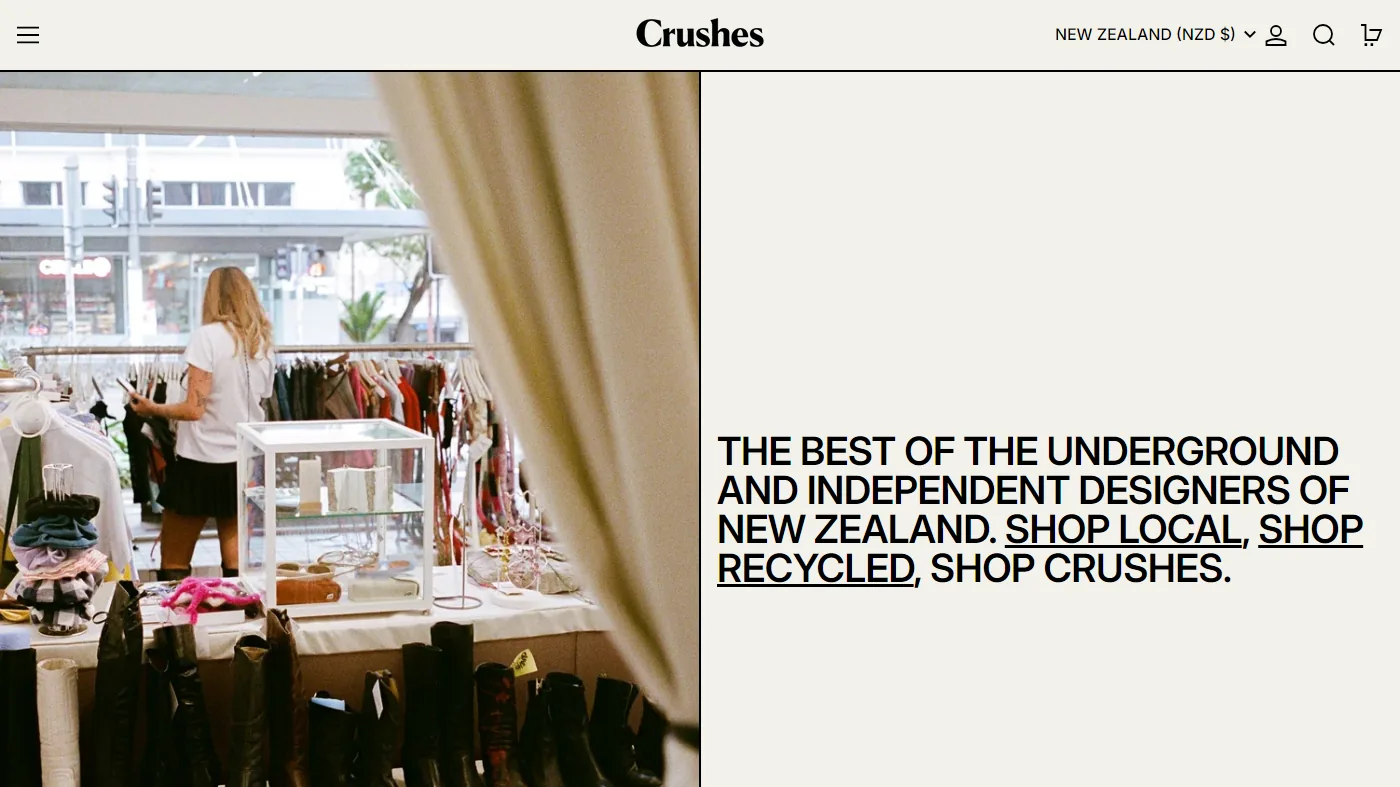 Concept StoreCrushes
Baseline theme build: shop-by-value landing page, A-Z maker directory, value-badge collection links, dated in-store event booking.
Read the case →When this is not the right fit
If you sell a small range at one price point in one language, a well-configured Dawn theme with good photography may be all you need, and we will say so on the first call. Our work earns its keep when variants, personalisation, pricing logic or multiple markets make the stock setup creak.
Tell us about your store
What you sell, where, and what is not working. We reply within 24 hours with a scoped next step.
Brief received.
Nice — your project is in. We will read it and come back within 24 hours with a scoped next step and a first concept, free.
Frequently asked questions
Can you handle right-to-left languages such as Arabic?
Yes. The Ouz Co runs English and Arabic side by side on one store with a fully mirrored right-to-left layout. That means logical CSS properties throughout the theme, mirrored carousels and forms, and hreflang for both versions — not a translation app bolted onto a left-to-right layout.
How do you deal with prices that change with the gold rate?
By computing them. Prices are derived from weight, metal and a rate you control, then pushed to variants in bulk, so a rate change updates the catalogue in one pass instead of hundreds of edits. We have written about the approach in the journal.
Do you build engraving and personalisation options?
Yes. Personalisation is built as structured line-item properties with validation, so an engraving reaches the order exactly as the customer typed it and the workshop never has to guess.
What does a jewellery store build cost?
Scope decides it. Focused work — a product-page system, a market launch — sits in the $500–1.5k band; a tailored storefront build in $1.5k–4k; full strategy, design and development at $4k+. You get a scoped roadmap before anything is built.
Which theme do you recommend for jewellery?
The one that fits the catalogue and the team. We have shipped jewellery stores on Prestige (The Ouz Co) and Horizon (UMI&UMI), and customise Dawn when the range is small. A theme is a starting point; the product-page system is the work.
Can you improve our existing jewellery store instead of rebuilding it?
Usually, yes. Most jewellery stores lose sales on the product page and in variant selection, both of which can be rebuilt inside an existing theme. We only recommend a rebuild when the theme’s structure is the problem.
Talk to the studio
Tell us what you are building. The first step is a scoped discovery pass — a prioritised roadmap before any build work starts.